The Emperor is not a card about power for its own sake. It is a card about structure. Where The Empress creates life and lets it grow, The Emperor builds walls, sets rules, and makes sure none of it falls apart. In a reading, this card almost always answers "what can I actually rely on here" — and the answer is "a system someone deliberately built."
Below is a full breakdown of the fourth Major Arcana: upright and reversed meanings, how it reads in love, career and money spreads, which cards shift its meaning, and where most readers get it wrong.
What The Emperor means in tarot
The Emperor is card number IV, following directly after The Empress. That order is deliberate: the two form a pair of ways to create order. The Empress does it through growth, warmth and nature. The Emperor does it through boundaries, law and will.
The core idea is simple: structure is a form of care. Not a cage and not an end in itself, but the way chaos becomes usable. That is why The Emperor rarely shows up as pure domination without a reason — behind the rules there is usually a purpose: to protect, to preserve, to actually finish what was started.
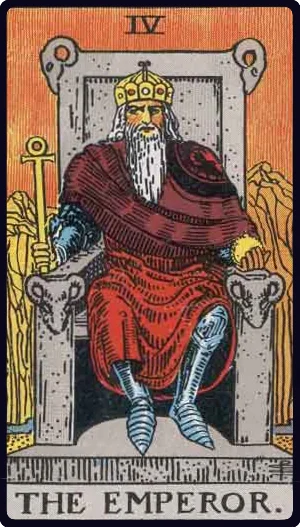
In the classic image, The Emperor sits on a stone throne with his back to bare mountains. He holds an ankh-shaped sceptre and an orb. Armor is visible under his red robe. Ram heads decorate the throne and the cloak. His gaze is direct, his face weathered, his beard grey. Every detail here is a reading instruction.
Reading the symbols
The stone throne and the mountains
The throne is carved from rock, not built — as if it had always been there. The bare, harsh mountains behind him are untouched by The Empress's careful cultivation. This is territory that had to be tamed by will, not grown patiently. If cards of nature and growth land nearby, look at the contrast: somewhere here, something needs to be built rather than waited for.
The ram heads
The ram is Aries — the sign of beginnings, drive and personal initiative. Ram heads on the throne and robe say that behind all this solidity is not a cautious bureaucrat but someone who once moved first and earned the right to set the rules. The Emperor was not born into his authority. He built it.
The ankh sceptre and the orb
The ankh in one hand is a symbol of life, of active and passive forces joined. The orb in the other hand is ownership — control over territory, whether that is a country, a company, or one's own life. Together they read simply: authority that serves life instead of crushing it. When the card reverses, this is exactly the balance that breaks.
Armor under the robe
The red cloak is activity and will, the same detail The Magician wears. But underneath it, unlike The Magician, is armor. That is the difference between "ready to act" and "ready to defend and hold." The Emperor is rarely about an impulsive move — it is about a position that still has to be held after it is taken.
The upright posture and the stern face
No smile, no ease. This is the card of someone who carries responsibility and knows the cost of getting it wrong. In a relationship or negotiation spread, it often describes the other person's manner quite literally — dry, businesslike, with little emotion on display.
The Emperor upright
Upright, this is a card of stability, order and earned authority. Main meanings:
- Structure that works. A plan, a system, a routine — whatever turns intention into an actual result. The card often shows up when scattered attempts need to become a clear course of action.
- Earned authority. Not power by title, but authority people recognise because the person genuinely carries the responsibility. Good for cards about leadership, expertise, reputation.
- Stability and protection. A foundation you can lean on: a home, an income, agreements that do not change every week.
- Discipline. The ability to see a plan through to the end, rather than only starting it on enthusiasm.
- A father figure. Literally or symbolically — a person, or a part of yourself, that sets the rules and takes responsibility for them.
- Long-range thinking. Decisions made with years in mind, not just next week.
If you need one phrase for the upright Emperor: build the system and it will hold you up.
The Emperor reversed
Reversed is not chaos replacing order — it is order that has gone out of control, or that is serving the wrong thing.
- Tyranny instead of leadership. Control for its own sake rather than for a result. Rules exist to dominate, not to protect.
- Rigidity. An inability to deviate from the plan even when the plan is visibly failing. "That's how it was decided" instead of "what actually makes sense now."
- Missing structure where it is needed. The flip side: no rules at all, no recognised authority, everything held together by promises that keep getting broken.
- Coldness. Function matters more than the person. A relationship or a management style where feelings are sacrificed for formal correctness.
- An absent father. Literally, or as a pattern — a lack of structure and protection in childhood that later shows up as difficulty setting one's own boundaries as an adult.
- Abuse of position. Using power, title or rank for personal gain at the expense of the people who depend on the decision.
The reversed key is: the structure exists, but it suffocates instead of protecting — or there is no structure at all where something is badly needed. Before reading this card as "tyrant," check the second option first: it may well be about a shortage of rules, not an excess of them.
The Emperor vs. The Magician
Both cards are about power and action, so they get confused, but the difference matters.
The Magician is the moment of launch: the resource is gathered, the tool is in hand, everything hinges on the first move. His horizon is here and now — one specific action. The Emperor is about what happens after the launch: how to hold the result, repeat it, turn a one-off win into a system that runs without constant hands-on management.
If The Magician in a new-venture spread says "start," The Emperor in the same spread is usually answering the next question — "how do I stop this from falling apart in a month." When the two land together, it is almost always a good sign: the idea is real, and there is the will to give it a durable shape.
The Emperor across spread topics
Love and relationships
Upright. A stable, serious relationship with clear agreements. A partner who takes on responsibility, protects, and plans ahead — sometimes older, sometimes simply more settled in their decisions. For singles, this points toward looking for someone reliable to build with, not a fling.
It can also describe a specific person: reserved, practical, not talkative, but someone you can count on.
Reversed. Control instead of care — a partner who decides for both people and does not tolerate disagreement. Or the opposite: a relationship with no structure at all, where nobody takes responsibility and everything runs on chance. If The Devil falls nearby, look harder at pressure and dependency — there is a full breakdown of that card here.
Career and work
Upright. One of the best cards for a leadership role, a promotion, or a business with a clear structure. It says that discipline and a systematic approach are already paying off, and it is time to formalise that — document the process, take on more responsibility.
Reversed. An authoritarian manager, a toxic hierarchy, rules for the sake of rules. Or the opposite — a workplace with no structure at all, where no one is clear on who owns what. If you are weighing a new job and this card comes up reversed, check the real management style rather than what the listing says.
Money
Upright. Financial stability through a system: a budget, a long-range plan, discipline in spending. A good time for decisions that need structure — a mortgage, a multi-year investment, formally registering a business.
Reversed. Either excessive control over money that tips into anxiety and hoarding, or the complete absence of a plan and impulsive spending. Worth figuring out which of the two poles you are currently in.
Health and energy
Upright. Routine and discipline produce results: a training schedule, stable sleep, regular check-ups. The body responds well to a system.
Reversed. The body tense from constant control, or self-care entirely chaotic — no routine, no boundaries. Often a sign to ease up on yourself rather than tighten the grip further.
Yes or no
Upright is yes, if you are willing to take on the structure and the responsibility that comes with it. This is not a card of easy luck — it is a card that says it will work if you build the system.
Reversed leans no, or at least not until the rules of the game — yours or someone else's — become clear.
Card combinations
The Emperor sets a frame; the cards beside it show what that frame actually serves.
- Emperor + Empress — will and growth balanced, a partnership where one builds and the other cultivates. The classic "ruling pair." See the full meaning of The Empress here.
- Emperor + Chariot — control plus forward motion; a strong combination for reaching a specific goal through discipline.
- Emperor + Tower — a system held together by force rather than a healthy foundation, and therefore collapsing. Worth looking at what exactly is built on fear. More on The Tower here.
- Emperor + Devil — authority used to control through fear rather than respect. Worth being honest about the motive here.
- Emperor + Star — discipline serving a larger purpose rather than order for its own sake. A good pairing for long projects. More on The Star here.
- Emperor + Hermit — structure built alone, through reflection, not through fighting the outside world.
- Emperor + Ten of Swords — a rigid system that has driven the situation into collapse; a sign the rules are long overdue for a rewrite.
- Emperor + Ace of Pentacles — a solid foundation for a new venture: plan, resources and will gathered in one place.
The Emperor and Aries
The Emperor is traditionally assigned to Aries and its ruler Mars — the energy of the first move, personal initiative, and the readiness to claim and hold ground. That explains why the card is rarely passive: Aries does not wait for permission, it goes and stakes a claim.
In Vedic astrology, Mars (Mangala) governs will, drive, boundaries, and the ability to defend what matters. A strong Mars in the chart describes someone who can set rules and hold them without tipping into unnecessary aggression. A weak or afflicted Mars produces the other side of The Emperor: either an inability to hold boundaries at all, or flashes of harshness and irritation instead of calm control.
A strong link between Mars and the Sun or Jupiter in a birth chart often produces exactly what this card describes — steady, recognised authority. If you want to see how Mars actually shows up in your own chart, the guide to Mars in the houses breaks it down house by house. A similar principle — authority earned through one's own effort — is covered in the piece on raja yoga in the birth chart.
Two worked examples
Question: "Should I finally register my business officially?" Situation position — The Emperor upright. Advice position — Ace of Pentacles.
Reading: the work is already running on your own discipline and system; what's left is turning that into a formal structure. The advice position confirms the foundation is there. The Emperor removes the doubt of "am I even ready for this" — you are, because the system is already working informally.
Question: "Why does my team keep having conflicts?" Cause position — The Emperor reversed. Obstacle position — Ten of Swords.
Reading: the problem is not the people, it's the system — either the rules are suffocating, or there are no real rules and authority gets fought over every time. The Ten of Swords nearby says the old management model has run its course and holding onto it further is pointless. The fix is to rebuild the rules, not replace the people.
Common reading mistakes
- Reading The Emperor only as "a strict man." The card is about the principle of structure and responsibility, not a specific gender or age — it describes a female executive or the querent's own inner discipline just as well.
- Confusing order with harshness. Upright, the card does not demand crushing everything human for the sake of rules — it is structure that serves a purpose. Harshness for its own sake is already the reversed meaning.
- Ignoring the neighbouring cards. A reversed Emperor next to growth cards (The Empress, The Star) more often points to a lack of structure than to tyranny — don't jump to the accusatory reading.
- Treating it as only about a boss. The Emperor describes a person's relationship with their own discipline and boundaries just as often as it describes an outside authority figure.
- Forgetting to ask whose structure it is. The key question for this card is "does this system protect me or restrict me" — it almost always produces a precise reading instead of a vague one.
Quick reference
- Upright: build the system, it will hold you up. Reversed: the system suffocates, or there isn't one at all.
- Themes: structure, responsibility, earned authority.
- Sign and planet: Aries and Mars — initiative, will, defending boundaries.
- Love: a reliable partner and clear agreements / control, or no structure at all.
- Work: a leadership role and systematic growth / authoritarianism or chaos.
- Yes-no: yes, if you take on the structure / probably not until the rules are clear.
- The question to ask yourself: does this structure protect me or restrict me.
If you want to see how The Emperor lands in your actual question, pull a reading on Solarius — cards come with a plain-language interpretation and can be read alongside your own birth chart.