The Tower is the card people quietly hope they will never pull. Lightning, a falling crown, two figures dropping through the air — the image leaves very little room for a comfortable interpretation. But once the first jolt passes, the 16th arcana is not really about disaster. It is about discovering that the structure you have been living inside was resting on something other than you assumed.
Let's read The Tower properly: what it means upright and reversed, how it behaves in love, career and money readings, how it differs from Death and the Ten of Swords, and — most usefully — what to actually do when it lands in your spread.
What the image shows
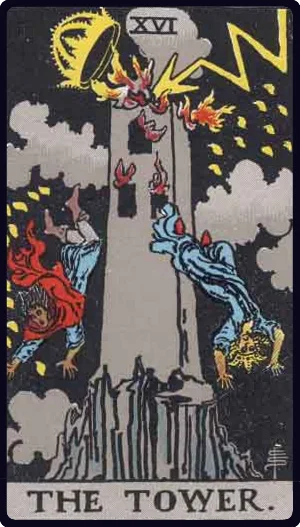
A tall tower on a rock. Lightning strikes the top, the crown is blown off the roof, flames pour from the windows, and two figures fall headfirst. The story is recognisable: any structure built on pride and on ignoring reality eventually takes its hit.
Three details tend to get missed:
- The crown comes off, the tower stays. The whole building does not collapse — the top does. What breaks is status, self-image, "how this looks from outside". The foundation is usually intact.
- The lightning comes from outside. A Tower event is rarely your decision. It arrives as a phone call, a message, a diagnosis, someone else's choice — and it does not ask whether you are ready.
- The figures are falling, not dead. In classic decks they are mid-air. The Tower is free fall, not the ending.
That gives you the key: The Tower is not a verdict. It is a forced reality check.
The Tower meaning in one minute
- Upright: sudden collapse, truth surfacing, an abrupt break, shock, liberation through disruption.
- Reversed: delaying the inevitable, collapse happening slowly and internally, fear of change, a smaller crisis or one already survived.
- Element and planet: fire, Mars.
- Number: 16, reducing to 7 — trial, a test of what holds.
- Core phrase: what can be destroyed, should be.
The Tower upright
In general
Upright, The Tower almost always points to an event rather than a mood. It is not "you will feel anxious" — it is "something will happen and the old configuration will not be available afterwards". And usually it is something that has been failing for a long time while you held it together by sheer effort.
Typical Tower storylines:
- Truth surfaces. The thing you suspected becomes a fact with evidence attached.
- A sudden break. Job loss, a breakup, a rejection, a deal cancelled after everyone treated it as done.
- A financial hit. An unplanned expense, an income stream disappearing, savings emptied by something urgent.
- Identity collapse. You stop being who you thought you were: the reliable one, the indispensable one, the one who keeps everything under control.
- Sudden clarity. Sometimes The Tower is internal — in one second you understand something you have been walking around for years.
In love and relationships
This is where The Tower gets read most harshly, so it is worth staying precise. Upright, it does not mean "he will leave tomorrow". It means the relationship is leaving the comfortable version of itself.
In practice:
- Something is exposed. Another person, a debt, a hidden dependency, a parallel life.
- The conversation finally happens. Years of unsaid things land in one evening, and afterwards nobody can pretend.
- An external shock tests the couple. A move, a job loss, a family illness — an event that reveals the actual structure of the relationship.
- A formal ending to something already over. The breakup after a long stretch of "we're working on it".
One frequent case: The Tower in a reading where everything looks fine. There it usually does not mean rupture — it means the convenient version of the relationship is about to stop working, and real terms will have to be negotiated.
In career
- A sudden layoff or restructure, announced with no runway.
- A project cancelled at the final stage.
- Conflict with leadership moving into the open.
- A collapsing income model — a platform changing its rules, a single large client walking away.
There is a flip side. The Tower shows up a lot for people who cannot bring themselves to leave. In those cases the card takes the decision off their hands. A surprising number of good career pivots started exactly where no option was left.
In money
Upright, The Tower in a money reading points to an unpredictable expense or the collapse of an income structure. The practical takeaway is unglamorous: an emergency fund, more than one source of income, and no all-in bets. If The Tower lands in a forecast position, it is not a reason to freeze — it is a reason not to sign anything long right now.
In health
In health readings The Tower indicates the abrupt rather than the gradual: an injury, a flare-up, a sudden diagnosis. The card does not diagnose and does not replace a doctor. What it flags is that the body has been signalling for a while and the "I'll push through" system has reached its limit. If The Tower appears in a health question, the sensible response is a check-up, not a better card.
The Tower reversed
Reversed, The Tower is often read as "you dodged it". Sometimes that is true. More often the meaning is subtler.
- A smaller-scale crisis. The collapse happens, but locally: not a firing but a demotion, not a breakup but a hard conversation.
- Delaying the inevitable. You can see the cracks and you are propping up the wall. The Tower still falls — later, and more expensively.
- Internal collapse. Everything stands from the outside and nothing stands inside. Frequently burnout, or a couple living as roommates.
- The crisis already passed. In a past position, reversed Tower reads as an upheaval you survived but have not yet drawn conclusions from.
- Fear of change as the actual subject. Sometimes the card is not about an event at all — it is about someone living in permanent anticipation of catastrophe and not moving because of it.
A simple test for choosing between these: look at the neighbouring cards. Stable, building cards nearby mean propping up and resisting. Heavy cards nearby mean the crisis is already running, just without visible drama.
How The Tower differs from other "frightening" cards
Three cards get confused constantly, and readings lose accuracy because of it.
- Death (13) — natural completion and transformation. It arrives on schedule, you can see it coming, and it is more about a chapter than a blow. Full breakdown in the Death tarot card guide.
- The Tower (16) — suddenness and an external hit. No warning, no preparation, structure broken.
- Ten of Swords — depletion and rock bottom. Not an explosion but "there is nothing left", the end of a long exhaustion.
One more pairing worth knowing: The Devil and The Tower travel together often. The Devil is attachment, dependency, an arrangement on bad terms. The Tower is the moment that attachment is severed by force. When they sit side by side, read it almost literally: whatever you are chained to is about to be detached, and not gently.
The Tower in combinations
- Tower + The Lovers — a hit to a relationship, or a choice made for you. More on the choice card in the Lovers guide.
- Tower + The Fool — collapse followed by a genuine restart. One of the most hopeful pairings; The Fool turns the fall into a beginning.
- Tower + The Star — the classic destruction-and-healing sequence. Recovery comes, but after.
- Tower + The Sun — truth coming out and turning out to be a relief.
- Tower + The Moon — deception surfacing; at worst, panic over nothing.
- Tower + The Emperor — conflict with structure: an institution, a boss, a father, a rulebook.
- Tower + Three of Cups — a rupture inside a friend group or a team; a scandal among your own.
- Tower + Four of Pentacles — losing the thing you were gripping hardest.
- Tower + Ace of Wands — a sharp new start after the hit; the energy that only appears when retreat is off the table.
The Tower as a yes or no answer
In yes/no draws The Tower usually reads as no — with a caveat. It does not answer the question on its own terms; it tells you the terms are about to change. Asking "will we agree on the current conditions?" — no. Asking "will something shift?" — yes, and faster than you would like.
The Tower in the advice position
This is the most underrated placement. As advice, The Tower says: stop propping it up. Stop holding together something that only stands because of your effort. It often lands as permission — to leave, to admit, to close the project, to say out loud what everyone already knows. The difference between Tower-as-event and Tower-as-advice is that in the second case you still get to dismantle the structure yourself instead of waiting for lightning.
What to do when The Tower shows up
A practical sequence instead of dread.
- Identify what is standing on sand. Ask directly: which part of my life holds together only because I avoid thinking about it? The answer usually arrives in seconds.
- Check the foundation, not the roof. The Tower removes the crown. Ask what remains once status, role and other people's opinions are gone — and whether that is enough. It usually is.
- Do not commit to anything long right now. A mortgage, a long contract, a large prepayment during a Tower period is a bad idea for a non-mystical reason: you are deciding from shock.
- Build a buffer. Financial and practical. It is the most concrete possible response to a card about suddenness.
- Separate the event from the catastrophe you built around it. Ask what literally happened versus what you added. The gap is usually large.
- Give yourself a deadline for conclusions, not for decisions. The Tower does not demand immediate action — it demands that you stop pretending. Decisions come weeks later, once the dust settles.
The astrology behind The Tower: Mars and suddenness
The 16th arcana is traditionally linked to Mars — the planet of abrupt action, conflict and severance. In Vedic astrology Mars (Mangala) has the same nature: fast, hot, cutting, but not malicious. Mars does not destroy for its own sake; it amputates.
That gives a useful cross-check. The periods when Tower events cluster are readable in a birth chart:
- Mars and Rahu periods in the Vimshottari dasha system — times of abrupt change in circumstances.
- Saturn transits over key houses — slow erosion that only registers as sudden because it went unnoticed for years. See the Sade Sati guide.
- A strong Mars in the chart tends to produce people who create their own Tower events — they cut ties and leave first.
None of this means the card is predicted by the horoscope. It means tarot and jyotish frequently describe the same process in two languages, and checking one against the other produces a soberer picture than either alone.
Common mistakes reading The Tower
- Reading it as death or disaster. The card gives no such indication. It indicates structural failure.
- Pulling clarifiers until something nicer appears. That is bargaining, not clarifying. A legitimate clarifier asks "in which area", not "are you sure".
- Ignoring the position. The Tower in "past" and The Tower in "outcome" are two different sentences.
- Deciding the same day. A Tower event always looks worse in the first 24 hours than it is.
- Forgetting the falling figures. There is no ground and no impact in the image. There is a fall — a state, not a result.
Quick FAQ
Is The Tower always bad? No. It is always irreversible. A large share of Tower events get rated, a year later, as the best thing that happened.
Can The Tower describe something good? Yes — a sudden offer, a move, a pregnancy, an abrupt change in status. What they share is that there is no going back.
How fast does it manifest? Fast. It is one of the quickest cards in the deck — usually days or weeks, not years.
What if The Tower keeps appearing on the same question? Stop asking and start acting. A repeating card is not fate; it is a sign the question is already answered and you are shopping for a different reply.
If you want more than a single-card lookup, try a tarot reading in Solarius: interpretations account for the position of the card in the spread and its neighbours rather than reading like a dictionary entry. And if you want to understand why Tower events are arriving now, build your birth chart and check which dasha period you are in.