The Devil is the card that makes people go quiet when it lands on the table. Horns, red eyes, two figures chained to a block. But look closely at the image and you will notice the detail that changes everything: the chains around their necks are loose. They can lift them off. Nobody is holding them there.
The fifteenth Major Arcana is not about external evil. It is about an attachment you chose and then stopped noticing. It is the card of addiction, of the deals you make with yourself at 2am, and of situations that have had an exit for years — the exit just never looked safe.
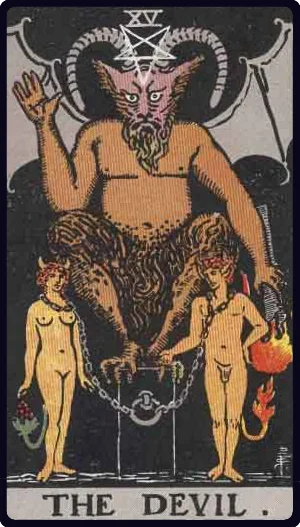
What the Devil card actually means
If you compress the arcana into one sentence: you are bound by something that gives you something. The bad relationship gives you the feeling of not being alone. The job you hate gives you predictability. The habit that is wrecking you gives you fast relief. The Devil does not judge that trade. It just puts it on the table.
Core upright meanings:
- Addiction and dependency — on a person, a substance, a status, money, someone else's approval. Anything filed under "I couldn't cope without it."
- Materialism — fixation on money and things as the only real safety. Not poverty; obsession.
- Codependency — a bond where two people hold each other with fear rather than love.
- The shadow self — what you refuse to admit is in you: greed, jealousy, the wish to control, rage.
- The illusion of no exit — the most common form. The person genuinely believes there is no choice, when in fact there is one and it is simply uncomfortable.
- Powerful attraction — desire that outruns judgement. Not always destructive, always consuming.
The Devil is not a prophecy of disaster. It describes a mechanism already running in your life — and usually you know about it, you just have not said it out loud.
How it differs from Death and the Tower
People collapse these three cards into one vague sense of doom. The distinction is clean:
- Death — the ending is already in motion, with or without your consent.
- The Tower — collapse arrives suddenly and from outside.
- The Devil — nothing is collapsing. Everything is very stable. That is the problem: the situation can run for years precisely because it is comfortable enough that you never move.
If you want the full trio, read the Tower and Death breakdowns — together they tell a coherent story about how things that no longer work finally end.
The Devil upright
Upright, the card describes the state of "I am stuck and I cannot see a way out." There is almost always a hidden payoff nobody wants to discuss.
In a general reading, the upright Devil says: look at what you are getting from the situation that is damaging you. Not what you are losing — what you are gaining. The answer is usually unflattering and extremely accurate. Until that payoff is named, no exit opens, because part of you keeps sabotaging every attempt to leave.
As a timing marker, the card means the situation will not change on its own. The Devil is static. It is not "wait and it will pass." It is "nothing moves until you decide."
The Devil in love and relationships
This is where the card bites hardest. Upright in a relationship spread it usually points to one of these:
- Intense sexual chemistry paired with total mismatch in real life. Miserable together, impossible apart.
- Codependency — one rescues, one drowns, and both roles feel too familiar to drop.
- Jealousy and control — checking phones, demanding accounts, control dressed up as care.
- A bond held together by fear — of being alone, of losing status, of starting over.
- A secret affair — something that cannot be shown and cannot be stopped.
An important nuance: the Devil does not automatically mean "leave." Sometimes it means "call it what it is." A couple that honestly names its dynamic can change it. A couple performing normality cannot.
If the card answers "what keeps us together," the Devil's reply is almost always habit and fear, not the reasons you say out loud.
The Devil in work and career
- The golden cage — paid just enough not to leave, not enough to live the way you want. The classic fifteenth-arcana plot.
- A toxic manager or team where you are steered by guilt or fear.
- Burnout you have relabelled as dedication — working till midnight because without it you feel like nobody.
- A questionable offer — lucrative, with terms you would have to stay quiet about.
- Career obsession — the goal is still there but stopped being yours a while ago, and you are still running.
If the Devil shows up on a new job question, do not refuse outright — read the whole contract. This arcana loves fine print.
The Devil in money
In a financial spread the upright card is nearly always about obligations you underestimated: loans, instalments, subscriptions, financial dependence on a partner or parents. It also covers impulse spending that delivers fast relief and slow damage.
The second common reading: money has become your only measure of safety. There can be plenty of it and still no sense of stability — because the hole is not in the budget.
The Devil in questions about yourself
When the card answers "what is going on with me," it usually surfaces the shadow: what you consider unacceptable in yourself and therefore push down. Anger, envy, hunger for power, greed. The Devil is not asking you to fix it. It is asking you to see it. A disowned shadow runs your behaviour far more forcefully than an acknowledged one.
The Devil reversed
The reversed Devil is one of the few cards that reads lighter upside down. The chain loosens.
Main meanings:
- Liberation — you are getting out of the dependency, the relationship, the arrangement. Sometimes painfully, but out.
- Realisation — the moment the mechanism becomes visible. "I do this because I am afraid" is already half the work.
- Reclaiming control — the decision is yours again, not the habit's.
- Dropping the illusion — about a person, a job, yourself. Seeing things at actual size.
- Recovery — the card often appears for people climbing out: of addiction, of debt, of a heavy relationship.
But there is a second, heavier face to the reversal — resistance to freedom:
- You have understood everything and continue anyway, because changing is scarier.
- The breakup happened on paper, but the bond is not released — messages, checking their profile, "just in case."
- The dependency changed shape rather than ending: you quit one thing and picked up another.
- Pettiness, indecision, negotiating with yourself about "maybe one more time."
Which face is yours? Read the surrounding cards, and answer honestly: over the past month, has it got easier, or just different?
Devil card combinations
The arcana shifts a lot depending on its neighbours. Reliable pairings:
- Devil + Lovers — a choice between honesty and convenience. Often a triangle, or a bond that needs naming. More on that choice in the Lovers card breakdown.
- Devil + Tower — freedom is coming, but not gently. The situation will break itself if you do not dismantle it by hand.
- Devil + Death — the cycle closes; the dependency falls away with the old version of your life.
- Devil + Star — there is a way out and it is closer than it looks. One of the most hopeful pairings.
- Devil + Moon — self-deception and fog. You are not seeing the whole picture; it is too early to decide.
- Devil + Sun — the hidden becomes visible. A secret arrangement or affair surfaces.
- Devil + Hermit — you need distance and a pause to see your own role in this.
- Devil + Magician — you have everything you need to change it. The only question is intent.
How to read the Devil without dread
Three practical moves:
- Ask the card "what is the payoff here." Not "how do I leave," but "what am I getting." The Devil answers that question more readily than any other.
- Check for literalism. Sometimes card 15 is not a metaphor at all — it is a specific contract, a loan, a person with an addiction, or simply a very physical relationship. Depth is not always required.
- Weigh the position. In a "past" slot the Devil is nearly harmless — it is experience. In an "advice" slot it reads differently: admit what you want instead of pretending you do not want it.
And above all: the card describes a state, not a sentence. States change the moment they get named.
The Devil and astrology
Classically, the fifteenth arcana is linked to Capricorn and Saturn — the planet of limits, structure, and the price of everything. The logic is clean: Saturn gives form, and form becomes a cage when you get stuck inside it.
In Vedic astrology the same job is shared by Saturn (Shani) and Rahu — the planet of compulsive craving and a hunger that never fills. If that lens interests you, read Rahu and Ketu in the houses and Saturn in the houses — same plots, different coordinate system.
In short
- The Devil is about chosen dependency, not external evil.
- Upright: being stuck, codependency, the illusion of no exit, consuming attraction.
- Reversed: liberation and insight — or active resistance to both.
- The card is static: the situation will not shift without a decision.
- The arcana's central question: what are you getting out of the thing that is damaging you?
Want to pull a card on your own question right now and read it in the context of its position? Do a spread in Solarius — and while you are there, build your birth chart and see where Saturn and Rahu are setting your terms.