The Hierophant is the card that says you don't have to figure everything out from scratch. Where The Emperor builds his own system, The Hierophant points to something that already exists — a tradition, a method, a school someone else built before you got here, and one that's often faster and more reliable to join than to reinvent alone. It's the card of the teacher, the institution, the ritual, and anything time has already tested.
Below is a full breakdown of the fifth Major Arcana: upright and reversed meanings, how it reads in love, career and money spreads, which cards shift its meaning, and where most readers get it wrong.
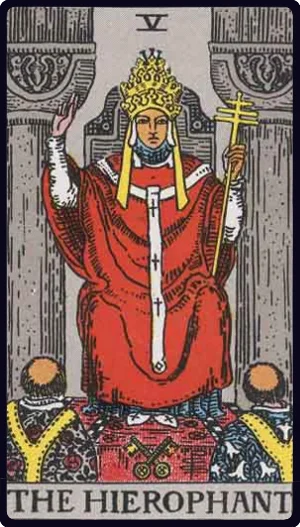
What The Hierophant means in tarot
The Hierophant is card number V, often labeled "The Pope" in classic decks. The Greek root of the word means "one who reveals the sacred" — someone positioned between ordinary people and knowledge that isn't directly accessible, whose job is to translate it into something usable.
The core idea is simple: knowledge becomes valuable once it can be passed on. This isn't about personal mystical insight — that's The High Priestess's territory. The Hierophant is about tradition, method, an institution already refined across generations and simply waiting to be entered. The card rarely shows up as a call to reinvent the wheel — more often it says, "this path is already built, walk it."
In the classic image, The Hierophant sits on a throne between two pillars inside a temple. He wears a triple papal tiara and holds a staff topped with a triple cross. His right hand is raised in blessing, two fingers up and two down — "as above, so below." Two acolytes kneel at his feet, their robes patterned with roses and lilies. Crossed keys, one gold and one silver, lie in front of the throne. Every detail here is a reading instruction.
Reading the symbols
The triple tiara
The three-tiered crown represents authority over three realms: spiritual, mental, and physical. Unlike The Emperor's plain crown, which is about territory, this one is about depth of initiation. The more deeply someone actually understands a subject, the more calmly and clearly they're able to explain it to a beginner.
Two pillars and a threshold
The Hierophant sits between temple pillars, much like The High Priestess sits between a black and a white column in her own card. But where the Priestess's threshold leads inward, into mystery, the Hierophant's leads outward — into a world where mystery becomes usable practice: a ritual, a discipline, a curriculum.
The staff and the blessing gesture
The staff is a symbol of spiritual authority used to guide rather than rule. The raised hand with parted fingers is still used in religious tradition today — not a command, but a transmission: "what I know is now available to you too."
The two acolytes
The kneeling figures are students, not yet initiated but already on the path. The roses and lilies on their robes echo the same symbols found on The Magician — apprenticeship requires both passion and purity. Their presence is a reminder: The Hierophant is never a solo card. It always describes a relationship — teacher and student, institution and newcomer.
The crossed keys
The gold and silver keys at the base of the throne belong to the conscious and the subconscious, to explicit knowledge and the hidden kind. The Hierophant holds both and knows which door to open when — that's his function as a mediator.
The Hierophant upright
Upright, this is a card of tradition, mentorship, and tested paths. Main meanings:
- Tradition and established rules. Institutions, rituals, methods that work precisely because many people have already gone through them. The card often shows up when a tested route makes more sense than experimenting.
- A mentor or teacher. A real person or a system that transmits knowledge in a structured way — an instructor, a spiritual guide, a mentor, a supervisor.
- Formal education and certification. School, a course, a credential that confers recognized status — not just personal experience, but something official.
- Belonging to a group. Joining a community and sharing its values and rules — a church, a professional association, an interest-based club.
- Marriage and formal commitment. One of the strongest cards for a wedding, an engagement, or formalizing a relationship — specifically in its conventional, socially recognized form.
- Spiritual guidance. Looking for answers through an existing belief system rather than through personal intuition — religion, a school of philosophy, a tested practice.
If you need one phrase for the upright Hierophant: the path already exists — walk it instead of blazing your own.
The Hierophant reversed
Reversed is not a rejection of all structure — it's structure that has stopped serving and become a cage, or a person consciously stepping outside it.
- Rebellion against convention. Refusing to follow rules simply because "that's how it's done." The card of someone choosing their own path, even when it's inconvenient for the people around them.
- Dogmatism. The flip side: rules followed formally, without any understanding of their purpose. Letter over spirit. An institution that suffocates growth instead of supporting it.
- Unconventional beliefs. Personal spirituality instead of organized religion, a self-made method instead of the textbook, trusting your own experience more than any outside authority.
- A break with tradition. Divorce, opting out of a formal wedding, leaving a family or religious script that no longer fits.
- A bad mentor. A teacher who manipulates, insists their view is the only correct one, or uses authority for control rather than for the student's benefit.
- Exclusion from a group. Being pushed out of a community, conflict with an institution, the sense of not belonging — sometimes a problem, sometimes an honest realization.
The reversed key is: this tradition no longer serves you — either change it, or stop pretending to follow it. Before reading this card as "rebellion," check the context: it may not be a revolt at all, but dogma that's suffocating someone who genuinely wants to belong and simply can't anymore.
The Hierophant vs. The Emperor
Both cards represent authority and structure, which is why they're easy to confuse, but the kind of power differs.
The Emperor is structure a person builds themselves — law, a system, the will of someone who took on the responsibility. The Hierophant is structure that already existed before you arrived and that you step into — tradition, an institution, collective knowledge built up across generations. One writes the rules; the other keeps and transmits them.
If The Emperor in a career spread says "build your own system," The Hierophant in the same spread is more likely answering, "there's already a system — join it through study, certification, a mentor." For a deeper look at that first, more personal kind of authority, see The Emperor. When the two land together, personal will and recognized authority are usually working in the same direction — a strong combination for official status.
The Hierophant across spread topics
Love and relationships
Upright. A serious, formally recognized relationship: an engagement, a wedding, moving in together with clearly agreed terms. For couples, this points toward the next conventional step. For singles, meeting someone is more likely to happen through a shared community, a course, a religious or professional setting than by pure chance.
It can also describe turning to a couples counselor or spiritual advisor for a question that's become hard to work through alone.
Reversed. A relationship that's held together only by "that's what's expected," not real closeness. Or, on the other side, a partner who resists any formal framework at all — no interest in a ring, no readiness for commitment. If The Lovers lands nearby, it's worth comparing: that card about a heart-led choice often clarifies that real closeness matters more than the form The Hierophant is pushing for.
Career and work
Upright. A good sign for formal training, a credential, or working inside a large, structured organization with a clear hierarchy and predictable path for growth. A mentor or manager who genuinely shares their experience can meaningfully speed things up.
Reversed. Bureaucracy for its own sake, a workplace where the paperwork matters more than the result. Or the pull to leave the corporate structure entirely for freelancing, a business of your own, or a work format that doesn't fit the usual mold.
Money
Upright. Financial decisions made through tested, conservative channels: a reputable bank, classic investments, advice from a financial professional rather than a risky experiment.
Reversed. Moving away from traditional financial institutions — alternative instruments, distrust of banks, a self-directed and unconventional approach to money. Not automatically a bad sign, but worth an honest look at the risk you're taking on without the system's usual safety net.
Health and energy
Upright. Turning to conventional medicine, trusting an established specialist, following a doctor's guidance instead of self-treating. A good time for a routine check-up with someone reputable.
Reversed. Disillusionment with standard protocols, a search for alternative practices, choosing your own path to health over a prescribed one. Worth being careful not to read this as a suggestion to skip medical care altogether — it's more about changing where the authority comes from than giving up on finding one.
Yes or no
Upright is yes, especially if the decision involves formal paperwork, education, or a well-tested route.
Reversed leans no in the conventional form, but can still mean "yes" through an unconventional route, if you're willing to go against the accepted rules.
Card combinations
The Hierophant sets the frame of recognized knowledge; the cards around it show how that frame gets used.
- Hierophant + Lovers — a wedding, an engagement, a couple formally recognized by everyone around them. One of the most direct marriage combinations in the deck. More on The Lovers here.
- Hierophant + Emperor — institutional power in its purest form: law, religion, and the state pulling in the same direction. Strong for a career inside a rigidly hierarchical structure.
- Hierophant + High Priestess — a conflict between dogma and intuition: an outside authority says one thing, an inner sense says another. Worth figuring out which one is actually telling the truth. More on The High Priestess here.
- Hierophant + The Fool — tradition meets a willingness to take a risk and start over; often a choice between a tested path and a leap into the unknown. More on The Fool here.
- Hierophant + Star — faith that heals instead of controlling; spiritual guidance that genuinely supports rather than restricts. More on The Star here.
- Hierophant + Tower — an institution or belief that was held together by fear of authority collapses, clearing space for something more honest. More on The Tower here.
- Hierophant + Devil — spiritual or institutional authority used as a tool of control rather than support. Worth being honest about who the rule actually serves.
- Hierophant + Two of Cups — a union sealed not just by feeling, but by a commitment both people formally recognize.
The Hierophant and Taurus
In the classical system of correspondences, The Hierophant is traditionally linked to Taurus and its ruler Venus — stability, the value of accumulated experience, and a pull toward what's already tested and trustworthy.
In Vedic astrology, Venus (Shukra) governs harmony, relationships, aesthetics, and the ability to find value in what's established rather than only in what's new. A strong Venus in the chart often describes someone who respects tradition and knows how to draw real benefit from it without losing their own taste. A weak or afflicted Venus can produce the reversed side of this card — either rule-following with no understanding of the point of the rules, or a blanket rejection of any established form, even where it would genuinely help.
If you want to see how Venus actually shows up in your own chart — where it brings harmony, and where it creates dependence on other people's approval — the guide to Venus in the houses breaks it down house by house.
Two worked examples
Question: "Should I take this course or go for the certification?" Situation position — The Hierophant upright. Advice position — Ace of Pentacles.
Reading: formal training really will pay off here — knowledge gained through a structured program will hold up better than trying to piece it together alone. The Ace of Pentacles in the advice position confirms this is a solid investment in the foundation, not empty paperwork.
Question: "Why does this family / this team feel so hard to be part of?" Cause position — The Hierophant reversed. Obstacle position — The Devil.
Reading: the problem isn't the rules themselves — it's that they're being used to keep people in line rather than to bring them together. The Devil nearby sharpens the theme of control and dependency — worth asking honestly whether this structure actually serves you, or only the people running it.
Common reading mistakes
- Reading The Hierophant as only "religion." The card is broader — any institution, method, or authority that transmits knowledge counts: a university, a professional community, a family tradition, not only a church.
- Confusing tradition with restriction. Upright, the card isn't about blind obedience — it's about a path that's already proven reliable. Restriction for its own sake is already the reversed meaning.
- Assuming the reversed card is automatically "bad." Sometimes it's just an honest signal that it's time to leave a system that no longer fits — not a problem, but a growth point.
- Skipping the question of whose authority it is. The key follow-up is whether this source of knowledge actually serves your growth or someone else's control over you.
- Forgetting the teacher-student pair. The card rarely describes just one side — it's about a relationship of transmission, and it's worth asking which role you're currently in.
Quick reference
- Upright: join the tested system, it won't let you down. Reversed: the system is suffocating you, or you've outgrown it.
- Themes: tradition, mentorship, formal recognition.
- Sign and planet: Taurus and Venus — stability, the value of accumulated experience.
- Love: engagement, wedding, formalizing a relationship / going through the motions without closeness, or refusing commitment.
- Work: training, certification, growth inside a hierarchy / bureaucracy, or a move to freelance or unconventional work.
- Yes-no: yes, especially in a conventional form / probably not the usual way, but possibly through an unconventional one.
- The question to ask yourself: is this authority moving me forward, or keeping me in place.
If you want to see how The Hierophant lands in your actual question, pull a reading on Solarius — cards come with a plain-language interpretation and can be read alongside your own birth chart.