The Hermit is the card that says the fastest way through a hard question is sometimes to stop asking everyone else and go sit with it alone. Where the Hierophant hands down answers through tradition and the High Priestess guards her knowledge behind a silent veil, the Hermit picks up a lantern and climbs the mountain to work it out himself. It's a card about pausing — not the exhausted kind of pause, but the deliberate kind you need to hear your own voice again under all the noise of other people's opinions.
Here's a full breakdown of the ninth Major Arcana card: what it means upright and reversed, how it plays out in love, career, and health readings, which cards shift its meaning, and why solitude in this card is a tool, not a diagnosis.
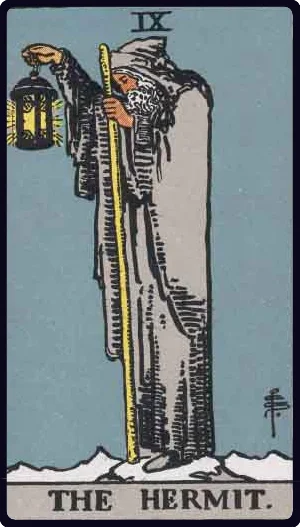
What the Hermit Card Means in Tarot
The Hermit is the ninth card of the Major Arcana. In the classic Rider-Waite deck, an elderly man in a grey cloak stands alone on a snow-covered mountaintop, leaning on a staff, holding out a lantern with a six-pointed star glowing inside it.
The core idea of the card: sometimes moving forward means stopping first. The Hermit isn't running from the world out of fear or resentment — he's deliberately stepping out of the noise to see clearly what the crowd makes impossible to notice. The lantern in his hand isn't lit to guide other people (though it often ends up doing that later) — it's there so he doesn't lose his own way in a question that has no answer yet.
The mountain under his feet is the ground he's already covered. The Hermit isn't a beginner or a runaway — he's a figure who has earned real experience (fittingly, this is the ninth card, near the close of the Major Arcana's first full cycle) and now uses that experience not to lecture anyone, but to be honest with himself. That's why the Hermit is so often called the card of mature wisdom: it doesn't arrive through outside advice, it arrives through the willingness to sit alone with a hard question for as long as it takes.
Symbolism: What to Read on the Card
The Old Man on the Mountain
The character's age isn't about literal years — it's about accumulated experience. The Hermit has already lived through enough situations that could have broken him, and that's what earns him the right not to rush his conclusions. The mountaintop is a vantage point: distance from everyday noise is exactly what lets you see the whole shape of a situation instead of just the piece in front of you.
The Lantern and the Six-Pointed Star
Inside the lantern sits the Seal of Solomon, a symbol that unites opposites — fire and water, spirit and matter — into one whole. The light here isn't bright or celebratory; it's a steady, quiet glow, just enough to take one more step, no more. In a reading, this almost always means the answer won't arrive as a sudden flash of insight but gradually, one careful step at a time, as the path slowly becomes visible.
The Staff
Support, not a weapon. The staff signals that the Hermit's solitude isn't helplessness or being lost — it's a deliberate choice to move slowly but steadily. He isn't afraid of walking the path alone, because he's learned to lean on himself.
The Grey Cloak
Grey is the color of neutrality, modesty, and having nothing to prove. The Hermit doesn't display his wisdom or try to impress anyone — the cloak literally hides the figure, leaving visible only what actually matters: the face, the lantern, the forward gaze.
The Snowy Summit and Solitude
Snow and cold aren't a punishment — they're the honest price of clarity. There's no hiding behind company on the summit, no getting distracted by someone else's opinion: up there, the only voice you can hear is your own. That's exactly why this card so often turns up at moments when someone needs to stop asking "what will people think" and start asking "what do I actually feel."
The Hermit Upright
The upright Hermit is a card of deliberate solitude, inner searching, and wisdom that comes through pausing. Core meanings:
- Introspection. The need to sit alone with a question instead of solving it on the run or with a room full of advisors.
- Seeking the answer within. A sense that the answer already exists inside you — it doesn't need to be found out there, it needs to be heard in the quiet.
- A deliberate pause. A conscious step out of the usual rhythm — not an escape, but a temporary sidestep that lets you come back clearer.
- Spiritual mentorship. Wisdom you want to pass on quietly, one-on-one, like a teacher rather than a preacher from a stage.
- Self-sufficiency. Comfort in your own company, the ability to stop depending on constant approval or company from others.
- Slow but steady progress. The lantern only lights one step ahead — and that's enough to keep moving without panicking over what you can't yet see.
If you need one phrase for the upright Hermit, it's: "the answer is where it's quietest — inside you."
The Hermit Reversed
The reversed Hermit isn't the absence of wisdom — it's solitude distorted, either into isolation or into refusing the alone-time you actually need.
- Isolation instead of solitude. Withdrawal that has stopped being a conscious choice and become a way to avoid people and problems.
- Loneliness as pain, not resource. A sense of disconnection from the world that drains you instead of restoring you — unlike the upright meaning, here the quiet doesn't help, it wears you down.
- Refusing needed help. Pride or the fear of looking weak keeps you from asking for support exactly when it would actually help.
- Ignoring your inner voice. You can feel that you need to stop and think things through, but you drown it out with busywork, noise, or other people's opinions.
- Forced solitude or forced company. Either you're being pushed into alone time you're not ready for, or you're being denied the pause you badly need.
- Coming out of prolonged withdrawal. Sometimes the reversed card is good news: a period of isolation is finally ending, and it's time to rejoin people.
The key to the reversed Hermit: "the quiet you're hiding in has stopped being shelter and become a cage." Before reading the card as "you need more alone time," check the opposite: the isolation may have already lasted longer than it's useful, and it might be time to step back into the light.
The Hermit vs. the High Priestess
Both cards are about inner knowledge and intuition, and both stand apart from the more active, outward-facing Major Arcana cards — but the way each one arrives at that knowledge is different.
The High Priestess keeps her wisdom behind a veil and waits: her knowledge comes through receptivity, intuitive reading, a stillness without action. She doesn't go looking — she already knows, and lets that knowledge surface when the time is right.
The Hermit, by contrast, actively searches. He picks up his lantern and climbs the mountain — his wisdom isn't given, it's earned through experience and the deliberate effort of sitting with a question alone. If the High Priestess answers "what do I already know intuitively but I'm afraid to admit," the Hermit answers "what do I need to do to finally hear the answer." When both cards show up in the same reading, it's often an invitation to trust not just experience and logic, but also quiet inner knowing — and to give yourself the time it takes to reach it.
The Hermit in Readings on Different Topics
Love and Relationships
Upright. For people already in a relationship, this is a sign that personal space matters more right now than constant closeness — a pause will benefit the relationship if both people respect it. For those who are single, it's a time to stop actively searching for a partner and figure out what you actually want from a relationship before letting someone else in again.
Reversed. Either one partner has shut down so much that the connection is fraying, or someone isn't getting the alone-time they need, and that's creating tension. Can point to a fear of intimacy disguised as "I just need some space."
Career and Work
Upright. A good time for research, analysis, or independent work — anything that rewards focus over group brainstorming. Can also mean mentorship: sharing your experience one-on-one rather than through large-scale training.
Reversed. Isolation from the team that's now getting in the way instead of helping — important information isn't reaching you because you've shut yourself off. Or burnout from never finding a quiet moment between back-to-back meetings.
Money
Upright. A careful, thoughtful approach to finances — a good time to research a decision yourself before trusting someone else's advice. Good period for planning alone, without rushing or outside pressure.
Reversed. Either excessive secrecy about money that keeps you from getting help you actually need, or anxiety from having to make decisions in isolation, without support.
Health and Wellbeing
Upright. Body and mind are asking for a pause: less outside stimulation, more quiet and rest. A good sign for solitary practices — meditation, retreats, days without your phone.
Reversed. Isolation that's deepening anxiety or low mood instead of easing it. Often a signal that it's time to come out of self-imposed withdrawal and reach out for support instead of carrying the difficulty alone.
Yes or No
Upright Hermit — yes, but not right away: the answer will come if you give yourself time to think it through alone, rather than demanding instant clarity.
Reversed Hermit — leaning no, as long as the decision is being made in isolation from information or support you actually need — deal with that first.
Hermit Card Combinations
The Hermit sets the format — withdrawal and searching — while the surrounding cards show exactly what needs to be found, or what to guard against.
- Hermit + High Priestess — an intuitive answer that finally gets heard after a long inward search.
- Hermit + Death — a period of solitude is wrapping up and giving way to change; the pause has done its job.
- Hermit + Moon — introspection risks tipping into anxiety and confusion rather than clarity; an outside reference point is needed, not just more inward searching.
- Hermit + Star — the lantern's small light gives way to a wider, clearer light of hope: the solitude delivered exactly the calm it was meant to.
- Hermit + Wheel of Fortune — one cycle is naturally wrapping up before the next one begins; the withdrawal here is part of a healthy rhythm, not a disruption of it.
- Hermit + Devil — worth double-checking: this solitude may not be a search for wisdom at all, but avoidance of an uncomfortable truth, or a dependency on isolation itself.
The Hermit and Virgo: The Astrology Connection
In Western astrology, the Hermit traditionally corresponds to Virgo, ruled by Mercury — attention to detail, an analytical mind, and the drive to work things out yourself before trusting a conclusion.
In Vedic astrology, Kanya (Virgo) is likewise ruled by Mercury (Budha), the planet of discernment, analysis, and practical intelligence. A well-placed Mercury in a birth chart often produces exactly the quality the Hermit describes: the ability to methodically work through a question on your own instead of settling for other people's rushed opinions. A weak or afflicted Mercury, on the other hand, can show up through the card's reversed meaning — excessive self-criticism, or anxious over-checking that circles endlessly without ever landing on an answer.
If you want to see how Mercury actually plays out in your own chart — which house it sits in and which area of life it governs — take a look at Mercury in the Houses: it breaks the energy down concretely rather than abstractly.
Reading the Hermit in a Real Spread: Two Examples
Example 1. Question: "Should I start dating again right now?" "Situation" position — upright Hermit. "Advice" position — High Priestess.
Reading it: the upright Hermit in the situation position suggests the more honest move right now isn't rushing toward someone new, but sitting with what the last relationship taught you. The advice card, the High Priestess, reinforces that: the answer to "am I ready" is already inside you — it doesn't need to be found through new dating, just given the time to surface.
Example 2. Question: "Why is this new team so hard for me?" "Cause" position — reversed Hermit. "What's hidden" position — the Devil.
Reading it: the reversed Hermit points to the difficulty living not in the team itself, but in how much more the person has shut down than the situation actually calls for. The Devil nearby hints that an old fear may be behind that isolation — something like "better to keep people at a distance so I don't get disappointed." The fix isn't "keep your distance," it's "figure out exactly what you're guarding against."
Common Misreadings
- Confusing solitude with loneliness as a problem. The upright card is almost always about a deliberate, resourcing choice to be alone — that's not the same as being abandoned or cut off.
- Reading the reversed card only as "you need more alone time." Just as often it means the opposite: the person is already more isolated than is healthy and needs to come back toward people.
- Ignoring the card's slow pace. The lantern lights one step at a time — expecting an instant, complete answer from the Hermit misreads the whole point of the card.
- Treating the card as a personality trait. The Hermit describes a temporary practice of going inward, not a permanent lifestyle — it turns up for very social people too, at the exact moment they need a pause.
- Forgetting the Virgo and Mercury connection. Without that context it's easy to miss that the card is about analytical, methodical searching, not just a vague longing to be alone.
- Not asking who or what the person is actually withdrawing from. Sometimes it isn't the world at large, but one specific person, situation, or expectation — clarifying that upfront makes the reading much sharper.
The Hermit and the Number 9: Closing a Cycle
Nine in tarot numerology is the second-to-last stop before the numbers reset to one in the next set of ten: it's a number of taking stock, though not yet the final word (that belongs to the next card, the Wheel of Fortune). The Hermit sits right at that threshold — he has already gathered the experience of the eight cards before him and needs to sit with it alone before the wheel starts turning again. That's why this card so often shows up not at the start of a journey, but somewhere near its midpoint — when the moment calls for reflecting on what's been covered, not launching something new.
Quick Checklist: The Hermit
- Upright — a deliberate pause and an answer sought within, slow but steady. Reversed — isolation instead of solitude, or refusing to hear what you already understand.
- Core theme — introspection, wisdom earned through experience, self-sufficiency.
- Sign and planet — Virgo and Mercury: analysis, discernment, methodical searching.
- Love: a useful pause and personal space / a withdrawal that's fraying the connection.
- Work: focused solo work or one-on-one mentorship / isolation from the team.
- Yes/no: yes, but not right away — the answer comes after a pause / leaning no, while the decision is being made in isolation from what you actually need.
- The question worth asking yourself: is my quiet a resource, or an escape.
If you want to see how the Hermit lands in your own question — try a reading in Solarius: the cards come with a clear, plain-language breakdown, and you can line them up against your own natal chart right away.